Sunday, 23 May 2021

Hartlepool area birding

 Weather forecast was for a dry day, so I decided to visit Hartlepool.

I followed the route that Chris had planned for us in the "good old days" of New Years Day birding.

Ward Jackson Park was my first stop, in the hope of seeing ring necked parakeets, but no joy.

However after walking around the park , just before I left I saw a nuthatch.


it was feeding young in this nest box. I was trying to keep out of view so as not to disturb the bird. However it was a dull cloudy day and there was little light under the tree.


Hartlepool Headland was my next stop. A group of birders were doing a sea watch and I caught the last few minutes. I missed the skuas but managed to see a manx shearwater. Lots of eiders were on the rocks along with herring gulls and cormorants and shags.


this turnstone was easy to see whilst it was feeding near the rocks. However when it was feeding on the seaweed it was not as easy to see.

Although the tide was coming in, there were no birds on the rocks at Newburn Bridge. A little further down the road at Seaton Carew, little terns are nesting on the beach.


Part of the beach has been cordoned off, and despite the large number of people using the beach, the 50 or so liitle gulls were very active. A couple of volunteers were keeping an eye on things.

North Gare road added goldfinch. shoveler and lapwing


Greatham Creek and the seal viewpoint was next on the list.

Little egrets, curlews, shelduck, redshank, dunlin, avocet, mallard and common terns were in the area. Across the road, common terns and black headed gulls were vying for nesting sites.


the birds are just about in the range of my camera, but they are so active and suddenly take to the air.

I then drove to RSPB Saltholme. I went to the Phil Stead hide, where a birder offered me his seat. I will sit and watch this bush he said, its more exciting. A gadwall and a pochard were on the water and that was it. It was very quiet bird wise everywhere. The list on the board had not been updated, so I presumed thatI had not missed anything. 

The guide in the hide at the Wildlife  watchpoint repeated the "its quiet" message and the board has not been updated. There must be a shortage of marker pens as none of the boards in the hides were upto date. Paddys Pool hide was empty which was good as I did not have to wear a mask.


How this canada goose family managed to end up in the middle of a black headed gull colony I don't know. The adults were mobbed all the time as they tried to protect their young one, which was too busy eating to notice what was happening.
Saltholme Pools hide was also empty so I could move from window to window as I wanted. In the distance a spoonbill was standing still.
it was probably closer to the road than the hide.
A family of canada geese were outside the visitor centre, a more sensible place to be.


Dormans Pool was my last stop. Not a lot of bird activity. I had hoped to see grasshopper, sedge and whitethroat in the brambles but not a sound.
From the hide I saw mallard, mute swans, great crested grebes and little egrets. There were 4 egrets but this one chased the others away.

I enjoyed watching the common and little terns, and seeing the nuthatch feeding was good, but overall it was a bit too quiet birdwise., but at least it was dry.

Thursday, 20 May 2021

3 ticks at Blacktoft.

 My original plan for today was to go birding in the Hartlepool area. However there was a lot of shopping required, so 4 shops and a lot of packing away saw me set off for Blacktoft just after 1pm. My friend Chris had sent me a message to say that a glossy ibis had been seen on the reserve. During my journey the rain poured down and I wondered if I should continue my journey. What if the reserve is full when I get there?

I carried on driving and the rain had nearly stopped by the time I arrived in the car park. Not too many vehicles which was a good sign. Daz was in the reception tent, so I stopped and had a chat with him. I think that the last time I saw him was before Xmas 2019.

Further along I saw Stu, Neil, John and Chris. They had all been working hard despite the rain, helping to keep the vegetation on the reserve in check. Pat was on duty in the reception hide, and we had a brief chat before I set off for Ousefleet hide. 

Before I went into the hide I had a quick scan from the screen. Mallard, black headed gull on its nest and a few swallows. Luckily for me the hide was empty so I was able to sit at the far end and not wear a mask.

Avocets were close to the hide.


They were chasing any birds away that came close to them, but I could not see any chicks.

To my right at the other side of the water, black headed gulls were very noisey. When I looked in their direction I could see them chasing other gulls. On close inspection I could see that the gulls the black heads were chasing were little gulls. I could see 1 adult and 4 immatures. However I did not find it easy to watch them due to the action of the black headed gulls.


A small group of black tailed godwits flew in.


Due to the rain showers the insects were flying low and they were hunted by swifts, swalllows, sand and house martins.

A pair of canada geese were watching their single chick.


A great tit landed on the 5 bar gate and started to search for food.


Chris, one of the volunteers, joined me in the hide, to watch the little gulls, which had returned.

While we were watching the little gulls we saw a bittern fly over the reedbed near the reception hide.

I was then thinking about moving on to the next hide, as it was now just after 2pm and the reserve closes at 6pm. I was just starting to pack my equipment away when it happened.


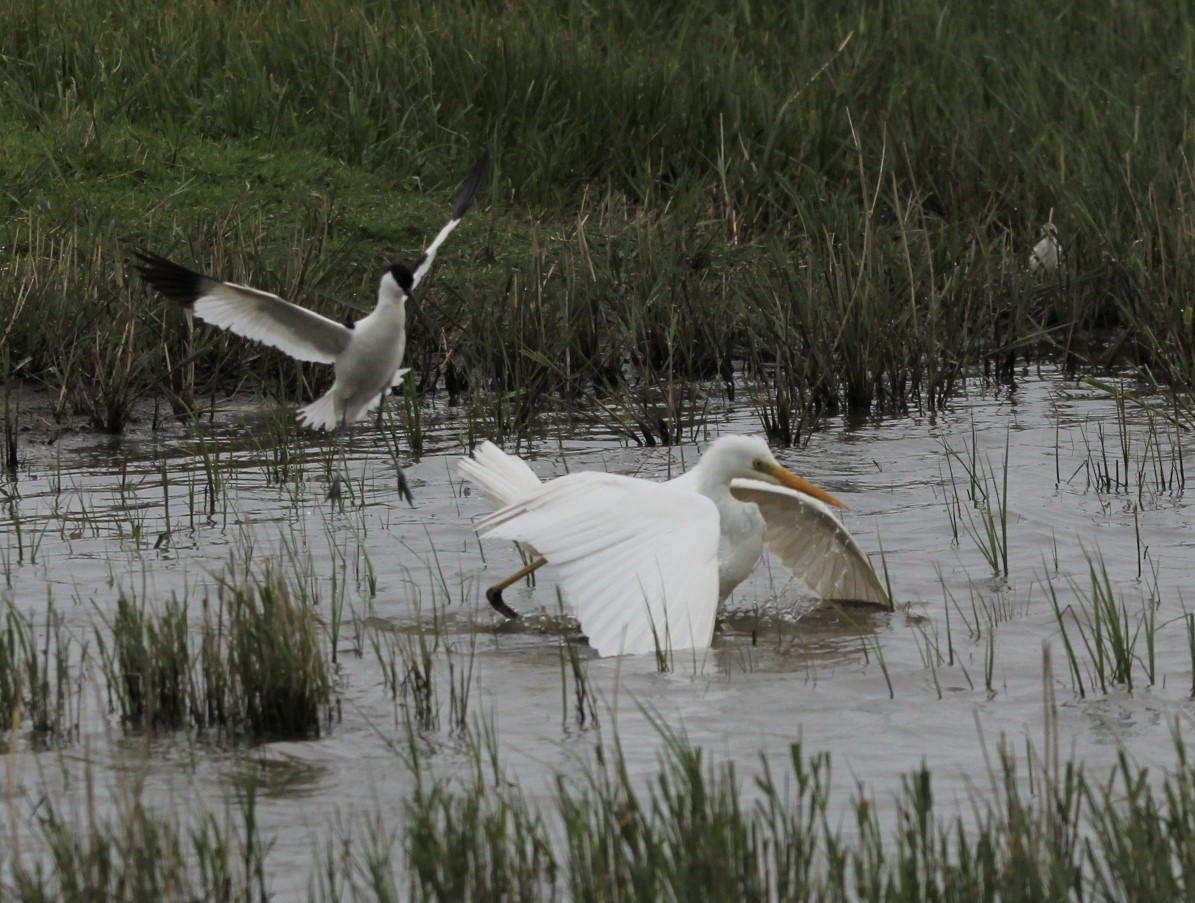
a great white egret came into land. This caused the adult avocets to go into attack mode.


the egret took off and flew over the reserve and the River Trent to Alkborough.


this was all over in just about 2 minutes.

The rain had stopped so I walked to Marshland hide. There is a notice on the boardwalk before you reach the hide asking you to keep quiet as there are avocets nesting close to 


the hide. I guess that this is one of the problems resulting from the lockdown.


 It was nice to see avocet chicks close to the hide.


There were lots of avocets on the scrape, I hope that they manage to rear some chicks, and keep the herons and marsh harriers at bay.

Xerox hide was my next stop. A few tufted ducks on the water, but most of the birds on the scrape were hirundines hunting low over the water.

I walked onto the reception hide where I spoke to Pat about the great white egret.

First hide and Townend had few birds on them so I moved on to Singleton hide. Three ladies were just leaving the hide as they had been there a while hoping to see otters, which had been reported earlier.

Marsh harriers were out hunting and this one cam a bit closer to the hide.


Two other birders arrived so I decided to leave the hide and left the reserve.

Tuesday, 18 May 2021

Two Norths

 Now that bird hides are now open I decided to visit North Cave Wetlands. It was fairly quiet when I arrived with only a few cars in the car park. The little butty van was not there, which may have accounted for the lack of vehicles. I parked at the far end of the road, near Crosslands hide.


As you can see from the photo it was a cloudy day with showers of rain. The water level on the scrape is fairly low and it was a pleasant change not to see and here lots of black headed gulls. On the scrape were mute swans, greylag geese with fairly large goslings, lapwings, little ringed plovers, redshank. No sign of the wood sandpiper that has been present recently.

Common terns were fishing.


The drake garganey came out of the reeds and had a sleep and then a preen.


I then walked along the path at the edge of the reserve and added wren, blackcap, chaffinch and cetti's warbler to my list. The cetti's flew too quickly for me to get a photo.


 I joined another chap in the next hide and keeping our distance we managed to get some photos of whitethroats.


sedge and reed warblers were also flying in and out of the reeds but were not as obliging as the whitethroat.  I walked back along the path towards my car and at the corner stopped to look for the tawny owl in this tree, but no luck.

South hide was my next stop, but there were very few birds on the water so I did not stay long.
I then drove towards the entrance to the reserve and parked my car. I went into the East hide from where I could see a single avocet, tufted duck, lapwing and black headed gulls.
Turret hide was my next stop from where the sound of black headed gulls can be deafening. Every bit of the islands are taken by gulls as nesting sites. Some of the gulls have chicks which are a yasty meal for the lesser black backed gulls, DONT LOOK AT THE NEXT PHOTOS IF YOU ARE A BIT SQEAMISH!!


The wind started to blow a bit stronger to I decided to leave the reserve and call in at another North on the way home. It was about 1pm when I reached North Duffield Carrs and met Alan Whitehead and Bud. We sat in the Geoff Smith hide for a while before Alan had to leave,

The young coot were now very mobile.


The mute swans are still sitting on eggs


as you can see from the photos the weather was still changeable, sunshine then showers. During one of the dry spells I walked down to the Garganey hide. Despite the heavy rain showers the water level is falling and the vegetation is growing which makes spotting birds a bit more difficult.


In the distance were 4 little egrets


along with two others feeding in the wet meadow these birds are becoming more common. How long before they start breeding here?

I counted 3 wigeon, lots of greylag geese, 60 mute swans, 1 black swan and the single whooper swan.


also on the bund was an Egyptian goose, my first of the year.


a march harrier disturbed the birds as it flew over


I walked back to the Geoff Smith hide where I sheltered from yet another rain shower.

I could just see the female deer and her young under some hawthorn bushes.


I left for home once it stopped raining.